| Bill Buxton Home | Next >> |
|
Birch Bark Canoe Project Bill Buxton |
 |
| Bill Buxton Home | Next >> |
|
Birch Bark Canoe Project Bill Buxton |
|
In the winter of 2007/8 my family history and my interest in the history of Canada morphed into a plan to do a canoe trip in northern Saskatchewan, following part of the old fur-trade route on the Churchill and upper Sturgeon-Weir Rivers, and especially visiting the communities of Stanley Mission and Pelican Narrows. One of the defining characteristics of the trip was the decision to do it in birch-bark canoes. What follows is a bit of a narrative - in words and image - of both the trip - which we did in the late summer of 2010 - and the canoes.
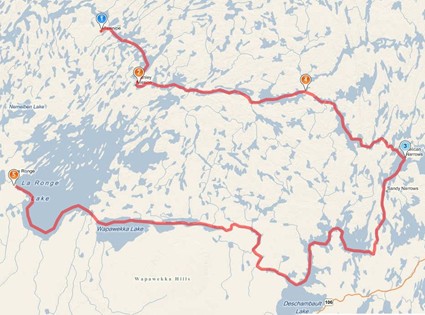 |
The route that we took is shown on the map to the left. It starts at the western edge of Wapawekka Lake, goes down the Deschambault River to Ballantyne Bay on Deschambault Lake, past the community of Deschambault Lake to the portage to Pelican Lake, up its south-west arm, past Sandy Narrows to the community of Pelican Narrows, where we stayed for two days. Then, on to Wood Lake, across Frog Portage, then up the Churchill River, past Stanley Mission, to Otter Lake, finishing at the village of Missinipe. Click on the map to the left to get an interactive higher resolution version of the route, and to see where this map fits into the larger geography of Saskatchewan and Canada. For on-line detailed route descriptions from the Canoe Saskatchewan web site, see: |
In 1939 and 1940, my father (also William Buxton) spent time in northern Saskatchewan as a teacher in a community called Pelican Narrows. There he helped establish an early non-residential school (that is, a school based right in the community, where they could go to school while live with their parents and remain exposed to their culture). The school was the idea of a remarkable man, Dr. Ahab Spence, who was the pastor at Stanley Mission. It was Canon Spence who recruited my father, who at the time was studying at Emmanuel College in Saskatoon.
The school only operated in the summer, since in those days, the majority of the community spend autumn through spring spread out in the north at their family hunting and trapping camps. The community only came together as a whole during the summer. Thus, this arrangement enabled the kids to stay with their families, learn traditional skills, yet still get schooling. Yes, that meant a long gap between school sessions, with inevitable consequences - one of the many difficult trade-offs that arose in the encounter between First Nations and European cultures in the north.
From the time that I was a child, tales and references to this part of my father's life were part of our family story. And, as I got old enough, part of this was manifest in my father telling me how we would someday revisit the area by canoe, to show me this part of the north and help me better understand what he had experienced, and why it had made such an impression. Well, that trip never happened - for many reasons. But as I got older - and him too (he is 92 at the time of my writing this) - I decided that I had to do the trip anyhow, hopefully with one of my sons, and do so while my father was still alive so that we could share our own story with him.
Hence this trip and this particular route.
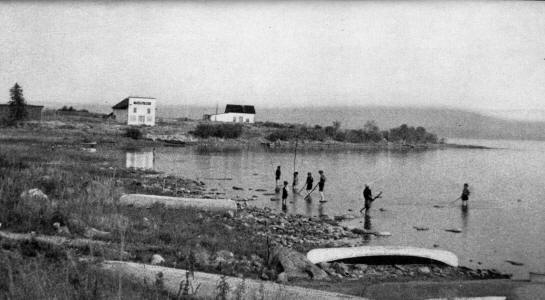 Pelican Narrows in 1939. The square fronted white building on the left is the old Révillon Frères trading post where the school was established. The building to the right was where the post manager had lived. This was to be my father's residence. However, when he entered, he promptly fell through the rotten floor boards. After a few nights camping out, he secured the use of a shack used by the Forestry Service. Photo: Downes, P.G. (1943). Sleeping Island. New York: Coward-McCann. |
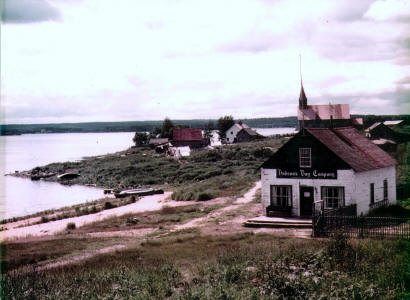 The Hudson's Bay Company trading post at Pelican Narrows in 1939. This photo was also taken by P.G. Downes on his trip in 1939. Downes was the first person to photograph this part of the north in colour. He and my father met at this time. Their card games at Pelican Narrows, among other things, are descrbed in Downes' 1943 book, Sleeping Island: The Story of one Man's Travels in the Great Barren Lands of the Canadian North. |
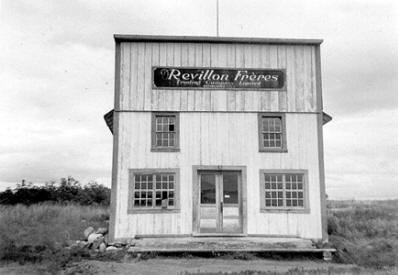 The Révillon Frères trading post where the school was established. You can see the situation of the building in the previous photo by Downes. Paris-based Révillon Frères - which later morphed into the cosmetics giant Revlon - started setting up their own fur-trading operations in the north in 1903 to compete with the Hudsons Bay Company, who eventually bought them out in 1936. Photo: W.W. Buxton. (1939). |
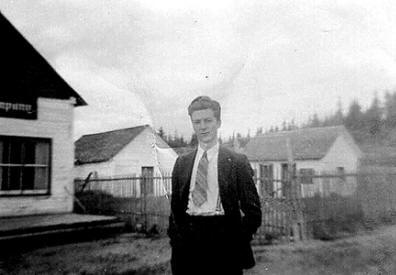 My father in 1939, outside the Hudson Bay trading post - the same one seen in the photo above. Given how he is dressed, this had to be a Sunday. |
The second thing about this trip was that I decided that it had to be done by traditional birch bark canoe. Now this is something that I have a read a fair bit about (browse my library if you like). On the other hand, at the time of the decision, I neither had a birch-bark canoe, nor had ever been in one. So, the next step in the plan was to find a builder who would tolerate me as an apprentice, and would let me help him build one that would be suitable for this particular trip. The result of this is that I spent as much time as I could (too little) in the summer of 2008 working with a builder in Northern Ontario, Tom Byers.
To access my pages documenting the canoe construction click here.
This was followed by having Tom build a second canoe in the summer of 2009 (this time with little help from me). The fact was, for safety reasons as well as company, I wanted to do the trip with more than one canoe. And, I wanted all of the canoes to be bark. So I bit the bullet and had the second one built. What the heck - how can you put a price on a dream?
As it turned out, my second canoe was not used on the trip. On the other hand, there was a second canoe, one that Tom built with and for my friend James MacLachlan.
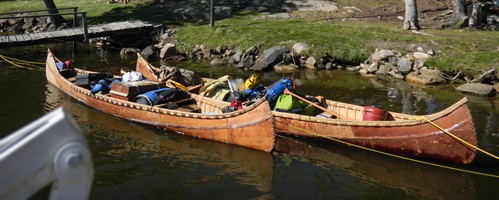 |
Jim and my canoes loaded and at rest. |
As for the trip itself, it was originally scheduled for the month of August, 2009 - a time picked to meet three objectives:
But, as one of the gang said, "Life happens," and sure enough it did. Close to departure, the 89 year old father of one of the team got ill, which precipitated 2 of the team having to drop out. Finding two experienced and compatible paddlers who could take a month off on a moment's noticewas an unsurmountable problem - and actually one that I didn't totally want to solve, given the team-mates, so the trip was been postponed for a year. My parents were duely instructed that they had to live at least one more year or risk ruining the trip. They didn't complain too much, and complied - all of which reinforces the notion that not only does life happen, it goes on, and we make the best of it.
In the meantime, the time opened up in the summer of 2009 was spent on shorter trips closer to home, thereby breaking in the canoes, and spending time working on white-water skills: all of which will make things all the better for the trip next year anyhow. Ahhhhh - the glass is half full after all!
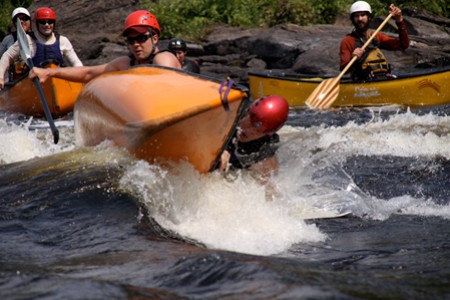 |
"In training" for the Churchill
River with my son, Blair (who was slated to be my canoe-mate on the trip
- but had to drop out due to a broken ankle from ice hockey).
Dumping in rapids is one thing in an unloaded plastic canoe, filled with
air bags, in warm water. It is a whole other thing in a loaded
bark canoe. They say practice makes perfect. On the other
hand, Voltaire said that the perfect was the enemy of the good.
The objective in this exercise is to purge any hero mentality, and
couple skill development - most importantly learning one's own
limitations. But is it ever fun! |
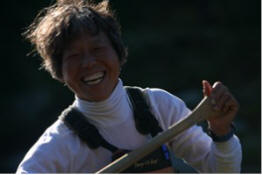
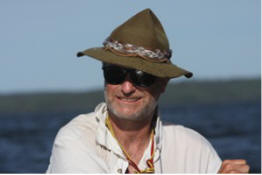
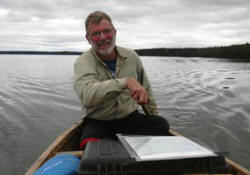
Finally, in 2010, all of the ducks more-or-less lined up and we made the trip. "We" consisted of four people: James Raffan, James MacLachlan, May Zhang, and myself, Bill Buxton. This was one canoe's worth less than originally planned, but unfortunatley three of the original crew, David Finch, Gail Simmons and my son Blair Buxton, all had to drop out during the planning stage. May was able to join on short notice to paddle with JM and JR and BB teamed up in the second boat, and we were off.
A photo record of the trip, with comments, can be found here.
Other things, such as a transcription of my journal, etc., may or may not appear in the future.
And, yes, it was as much fun, as interesting, and fulfilling as the images suggest.
 |
 |
 |
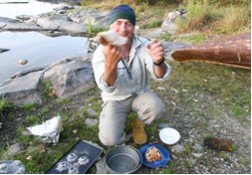 |
| May Zhang | James MacLachlan, | James Raffan | Bill Buxton |